
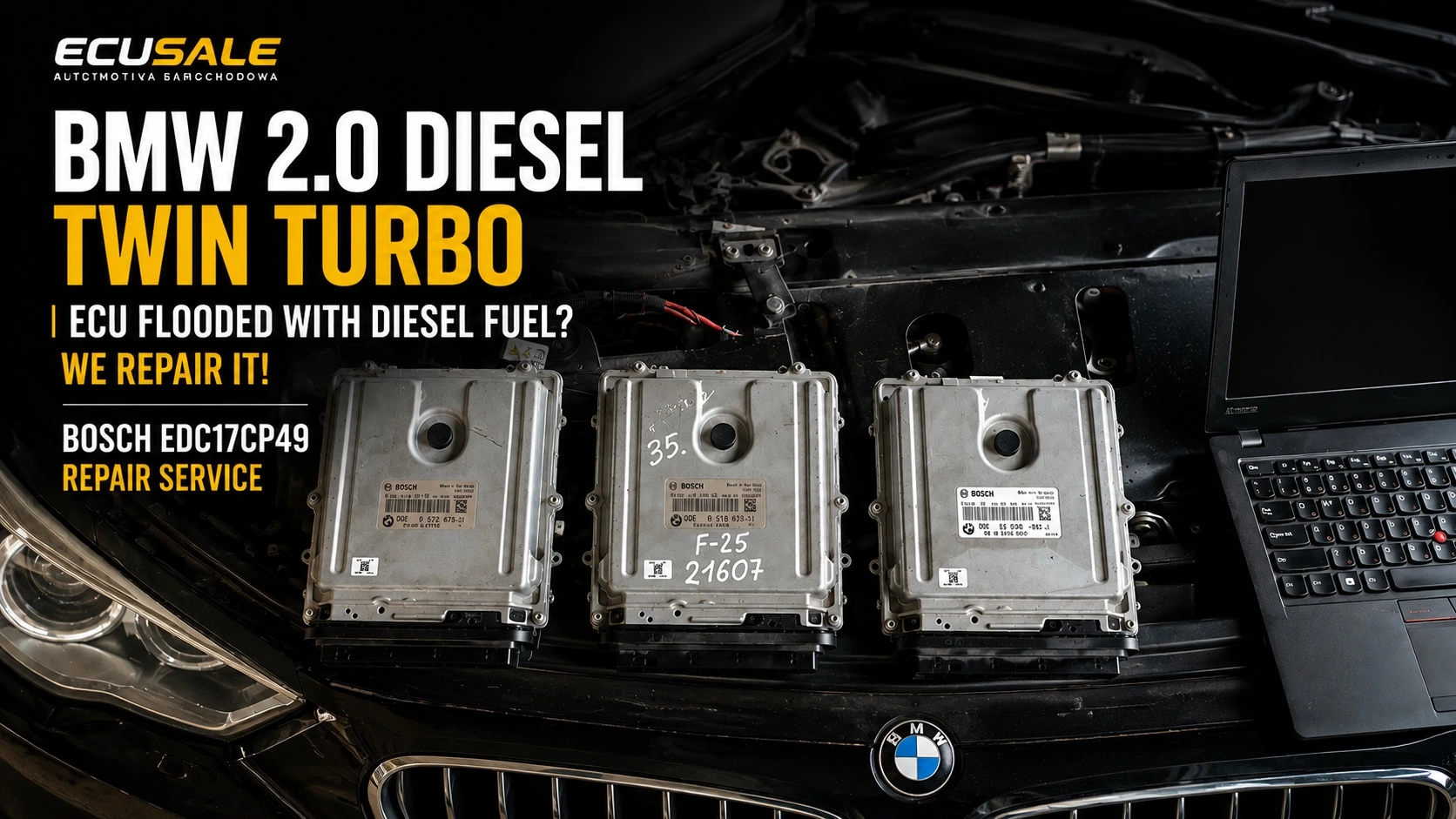
Has the engine ECU in your BMW 2.0 diesel been contaminated with diesel fuel? A loss of communication with the ECU, starting problems or diesel fuel visible inside its connector may indicate an electronic fault. At ECUSale, we diagnose, repair, refurbish, clone and program BMW engine ECUs. We also stock tested replacement modules that can be prepared for a specific vehicle.
Do you need a BMW ECU repair or a tested replacement unit? Send us a clear photograph of the complete ECU label so that we can perform an initial compatibility check and provide a quotation.
Phone: +48 888 638 546
Email: sale@ecusale.com
Table of contents
- Why does diesel fuel enter the BMW ECU?
- Symptoms of a damaged BMW engine ECU
- Common fault codes
- What should be checked before refitting the ECU?
- BMW ECU repair, cloning and programming
- BMW ECU repair cost
- BMW ECUs for vehicles with and without AdBlue
- Tested BMW engine ECUs for sale
- BMW models that may be affected
- How does the repair service work?
- Why choose ECUSale?
- Related articles about liquid-damaged ECUs
- Frequently asked questions
- Contact ECUSale
Why does diesel fuel enter the BMW engine ECU?
In some BMW models equipped with a 2.0 diesel engine, diesel fuel can travel through the wiring harness and reach the engine control unit. The problem may affect different versions of Bosch ECUs used in BMW diesel vehicles.
One of the most common causes is a leaking Common Rail fuel pressure sensor. Diesel fuel enters the sensor’s electrical connector and can then travel inside the wires until it reaches the engine ECU connector.
Once diesel fuel enters the ECU, it may cause:
- corrosion of the printed circuit board,
- damage to PCB tracks and electrical connections,
- short circuits in electronic components,
- damage to power supply and CAN communication circuits,
- loss of communication with the ECU during diagnostics,
- starting problems,
- a complete vehicle no-start condition.
The fault often develops gradually. The driver may not notice the leak for a long time. The first clear symptom may be an engine that will not start or a complete loss of communication with the engine control unit.
Important: before fitting a repaired or replacement ECU, the source of the fuel leak must be eliminated and the wiring harness must be checked. Otherwise, a fully working ECU may become contaminated and damaged again.
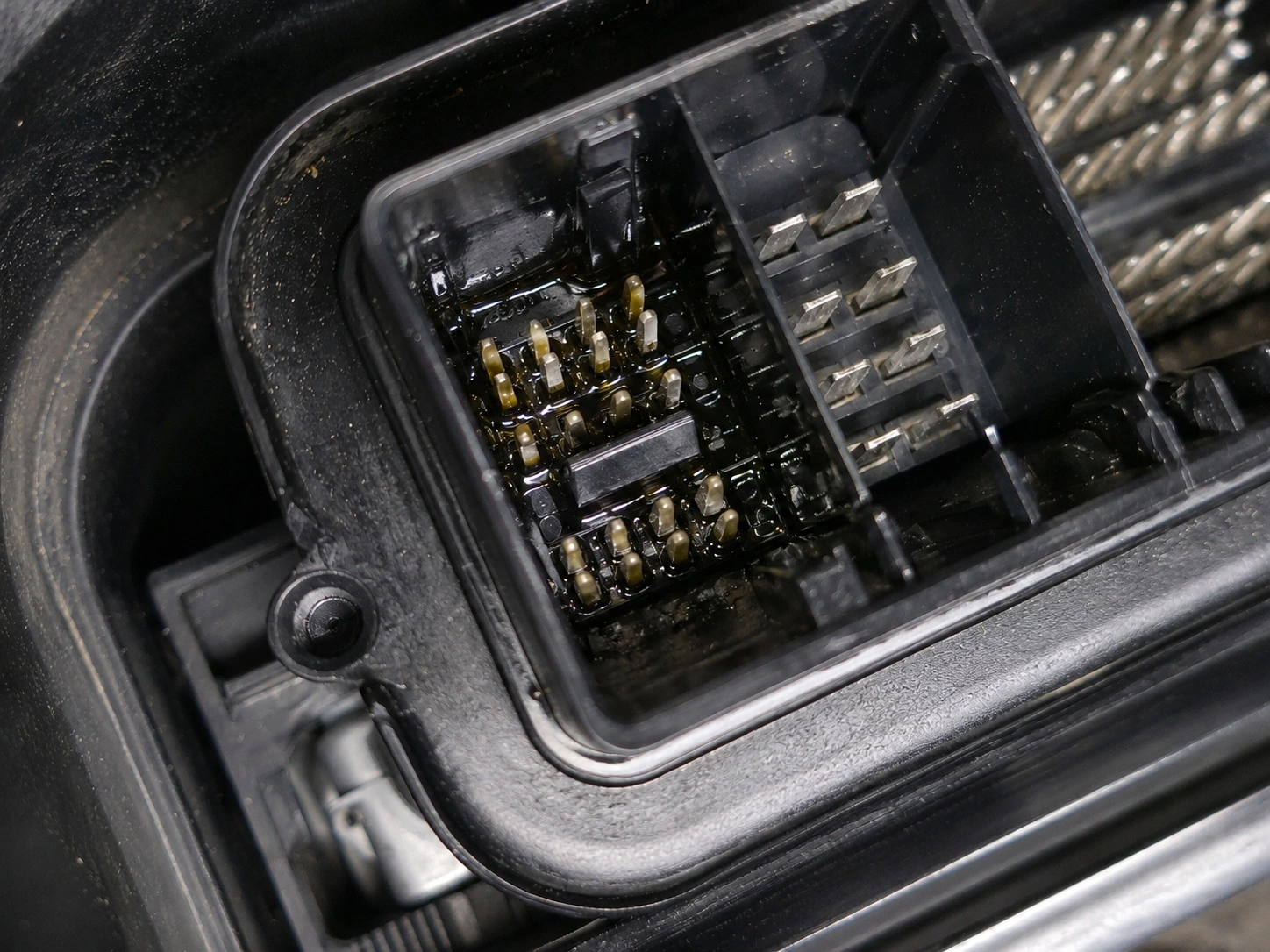
The image below shows a BMW engine ECU connector contaminated with diesel fuel. Fuel is visible around the terminals and in the lower section of the connector. This condition can cause corrosion, short circuits and loss of communication with the ECU.
Symptoms of a damaged BMW engine ECU
The symptoms depend on the location and extent of the electronic damage. At first, the problem may occur only intermittently. As corrosion or an internal short circuit develops, the fault may become permanent.
Most common symptoms
- no communication with the engine control unit,
- the engine cranks but does not start,
- the engine stalls while driving and will not restart,
- the engine warning light does not illuminate when the ignition is switched on,
- multiple CAN bus communication faults,
- no injector or fuel pump control,
- the ECU cannot be identified during diagnostics,
- intermittent starting problems,
- diesel fuel visible inside the ECU connector or around its terminals,
- a strong smell of diesel fuel inside the ECU housing,
- visible corrosion on the circuit board.
Similar symptoms can also be caused by wiring faults, missing power supplies, poor ground connections or problems elsewhere in the fuel system. For this reason, we test every ECU we receive before starting the repair.
After diagnostics, we determine whether the original module can be restored or whether a tested replacement ECU would be a more reliable solution.
Common fault codes associated with BMW ECU failure
Problems involving the fuel pressure sensor, electrical wiring or engine ECU may generate the following generic OBD fault codes:
Fuel pressure sensor and rail pressure faults
- P0190 – fuel rail pressure sensor circuit malfunction,
- P0191 – fuel rail pressure sensor range or performance fault,
- P0192 – fuel rail pressure sensor circuit low input,
- P0193 – fuel rail pressure sensor circuit high input,
- P0194 – intermittent fuel rail pressure sensor signal,
- P0087 – fuel rail or system pressure too low,
- P0088 – fuel rail or system pressure too high,
- P0090 – fuel pressure regulator control circuit fault.
Engine ECU communication faults
- U0100 – lost communication with the engine control module,
- CAN bus communication faults stored in other vehicle modules,
- no response from the engine ECU during diagnostics,
- the ECU cannot be identified or read.
BMW-specific fault codes may also be stored and displayed in ISTA. However, a fault code alone does not prove that diesel fuel has entered the ECU.
The fuel pressure sensor, connectors, wiring harness, power supplies, ground connections and internal condition of the ECU must also be checked.
A loss of communication does not always mean that the ECU must be replaced. In many cases, the module can be repaired while preserving its original data and vehicle configuration.
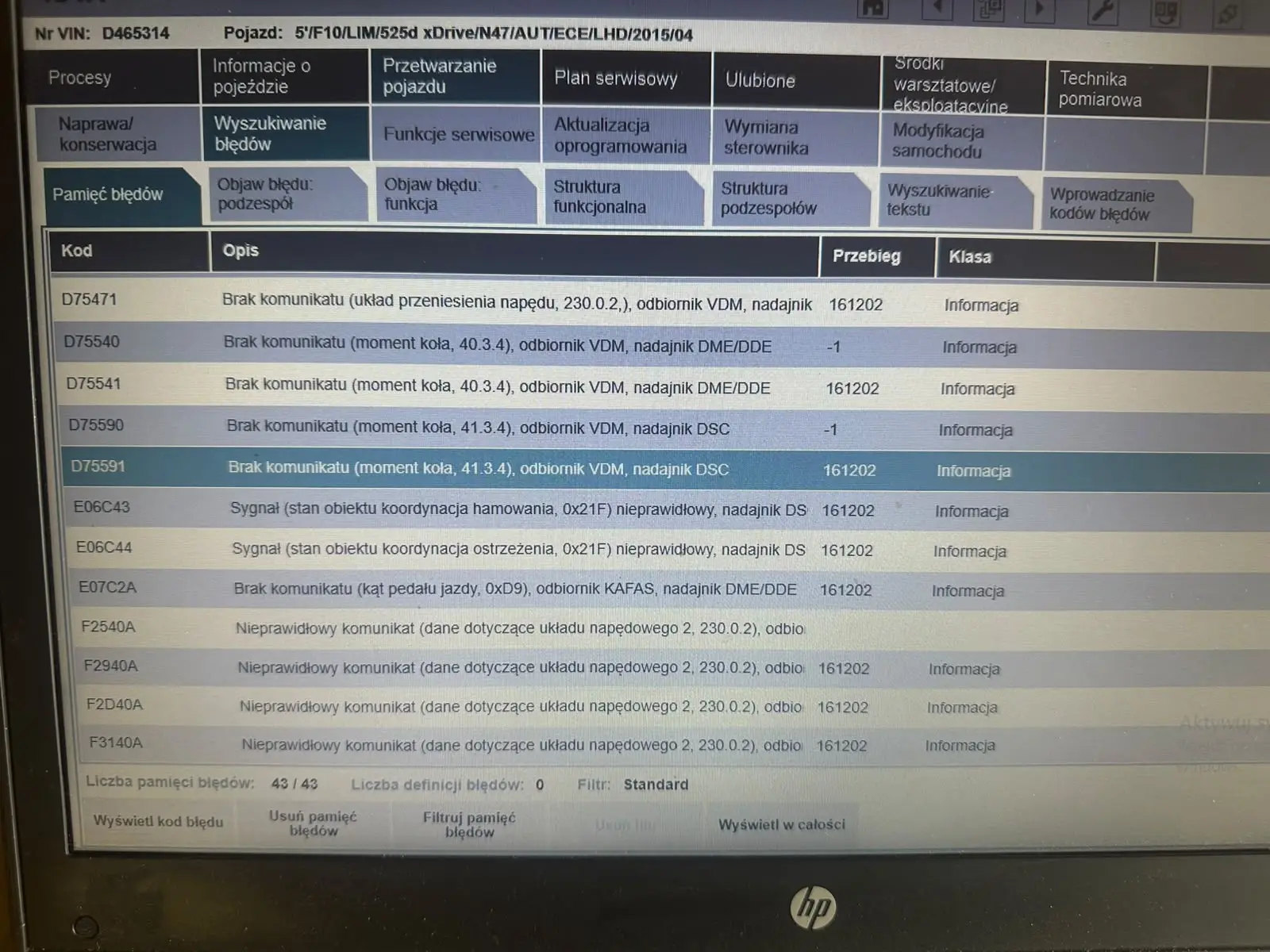
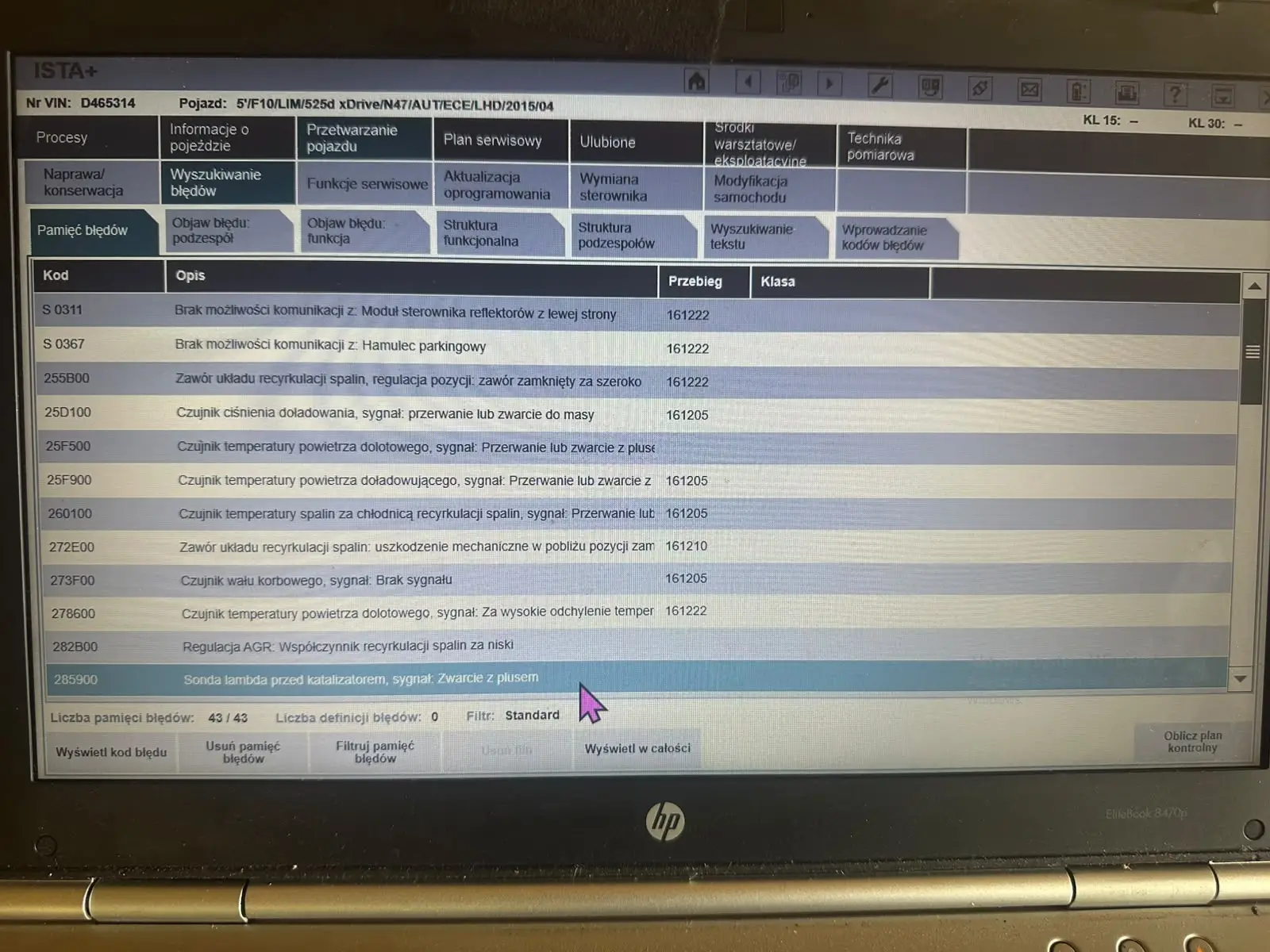
The images below show an example diagnostic scan carried out using BMW ISTA. Multiple communication faults involving the engine ECU and several sensor or actuator signal faults are visible.
This group of faults may indicate a problem with the ECU or wiring harness. However, the power supplies, ground connections and CAN bus must always be tested before confirming the diagnosis.
What should be checked before fitting a repaired ECU?
Repairing the engine ECU does not remove the cause of the diesel fuel contamination. Before refitting the module, the fuel system and wiring harness must be carefully inspected.
1. Replace the leaking fuel pressure sensor
A leaking fuel pressure sensor must be replaced with the correct new part for the specific engine version. Leaving the faulty sensor in the vehicle may allow diesel fuel to enter the wiring harness and damage the repaired ECU again.
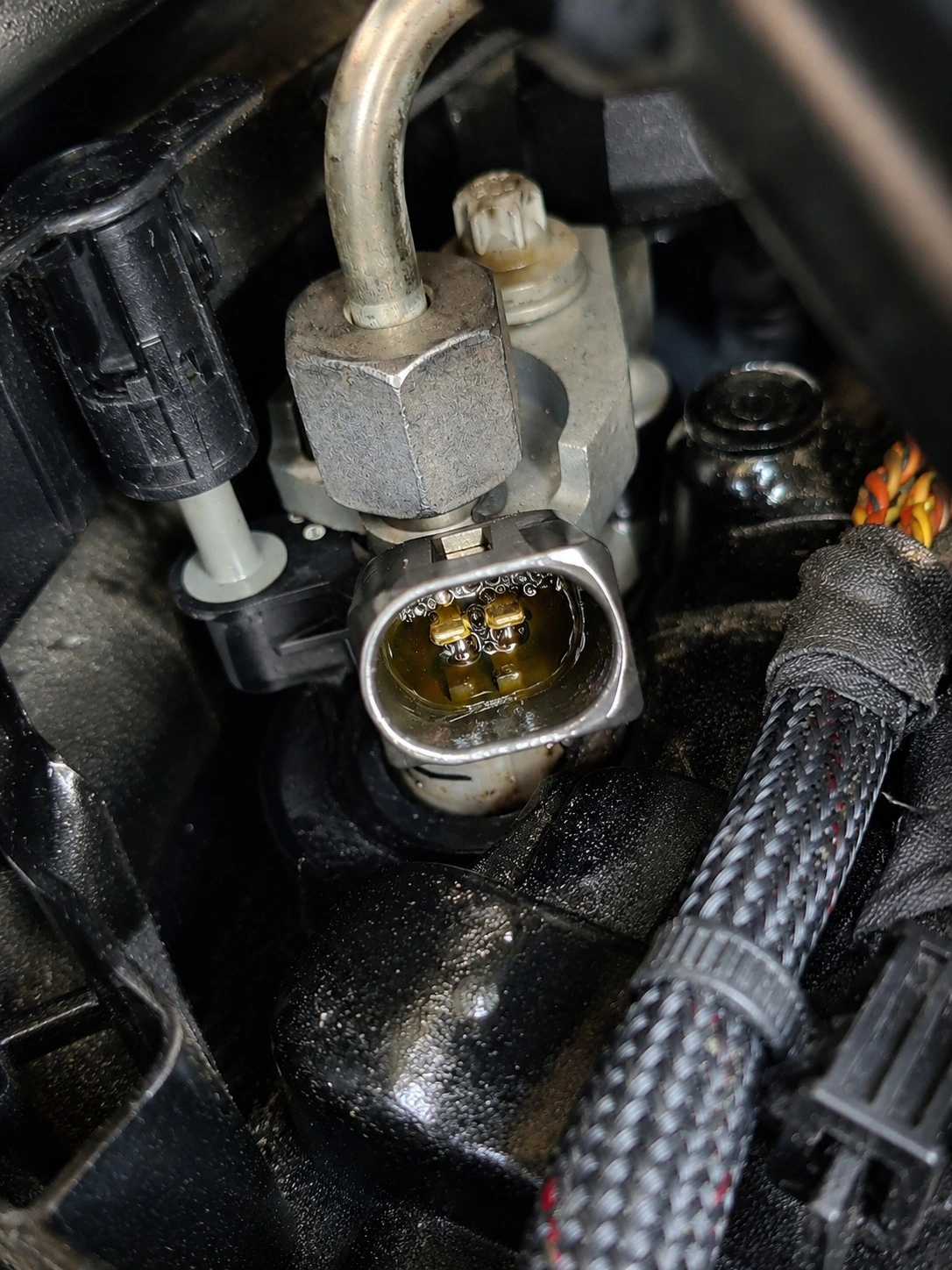
The photograph below shows a leaking fuel pressure sensor in a BMW N47 engine. Diesel fuel is clearly visible inside its electrical connector.
From this point, the fuel can enter the wiring and travel through the harness until it reaches the engine ECU connector.
2. Inspect the connectors and wiring harness
The wiring between the fuel pressure sensor and the ECU must be checked carefully. If diesel fuel has entered the insulated wires, cleaning the connectors alone may not be sufficient.
Fuel may continue to travel through the inside of the wiring harness and reach the ECU again.
3. Replace contaminated or damaged wiring
Wires that are saturated with diesel fuel, deformed or affected by damaged insulation should be replaced. A repaired or prepared ECU should only be fitted after the source of the leak has been removed and all diesel fuel contamination has been eliminated from the wiring harness.
BMW ECU repair, cloning and programming
At ECUSale, we repair BMW engine control units damaged by diesel fuel. Every ECU is assessed individually because the extent of the damage depends on the amount of fuel, the duration of the leak and the level of corrosion inside the module.
BMW ECU repair process
Depending on the condition of the module, the service may include:
- opening and diagnosing the ECU,
- removing diesel fuel from inside the housing,
- professional cleaning of the printed circuit board,
- removing corrosion and contamination,
- repairing damaged PCB tracks and electrical connections,
- replacing damaged electronic components,
- repairing power supply circuits,
- repairing CAN communication circuits,
- reading and securing the original ECU data,
- bench-testing communication and operation before dispatch.
When the original ECU can be repaired, its existing data, configuration and immobiliser-related information remain stored in the vehicle’s original module.
BMW ECU cloning and replacement preparation
If the electronic damage is too extensive, we can prepare a compatible tested ECU. When the original module can still be read, we transfer the necessary information to the replacement ECU.
Our services include:
- engine ECU cloning,
- transfer of immobiliser and vehicle-specific data,
- engine management software programming,
- preparation of a Plug & Play replacement ECU,
- preparation of a VIRGIN ECU ready for adaptation to the vehicle,
- configuration of the replacement unit according to the vehicle’s equipment.
The possibility of cloning depends on the condition of the processor and memory inside the damaged ECU. If the data cannot be read safely, we will recommend another solution suitable for the vehicle.
How much does BMW ECU repair cost?
The repair cost is usually between €350 and €400, depending on the ECU version, the extent of the damage, the level of corrosion and whether the original data can be recovered.
For comparison, a tested and fully working used ECU often costs approximately €950. When the original module can be repaired, refurbishment is therefore a considerably more economical alternative to purchasing another ECU.
The final price is confirmed after the module has been received and diagnosed.
BMW ECUs for vehicles with and without AdBlue
BMW 2.0 diesel engine control units are available in different hardware and software versions. We support vehicles equipped with the factory AdBlue SCR system as well as versions without AdBlue.
The differences may involve the engine management software, vehicle configuration, exhaust aftertreatment system and, in some cases, the internal electronic design of the ECU.
Before supplying or preparing a module, we verify the complete ECU part numbers, hardware and software versions, and the vehicle’s equipment.
AdBlue OFF, EGR OFF and DPF OFF
On request, we can also carry out software modifications such as AdBlue OFF / SCR OFF, EGR OFF and DPF OFF.
These services are provided only for applications permitted by the laws of the country in which the vehicle is used, for example motorsport, testing, export or off-road use.
How do we identify the correct BMW ECU?
To verify compatibility, please provide:
- a clear photograph of the complete label on the original ECU,
- the Bosch ECU number and BMW part number,
- the vehicle identification number (VIN),
- the BMW model, year and engine power,
- confirmation of whether the vehicle has AdBlue and a DPF,
- the required service: repair, cloning, programming or ECU purchase.
Tested BMW engine ECUs for sale
In addition to repairing modules contaminated with diesel fuel, we supply tested BMW engine control units from our own stock.
The modules are opened and inspected for diesel fuel contamination, corrosion, damaged PCB tracks and evidence of previous unprofessional repairs.
ECUs showing signs of contamination, corrosion or unreliable previous repairs are not approved for sale. A purchased module can be cloned, programmed or prepared for the customer’s vehicle.
Examples of BMW 2.0 diesel ECU part numbers
The list below includes examples of modules that we repair or can prepare. It is not a complete list of supported BMW engine ECUs.
- BMW 8586538 / Bosch 0281031947
- BMW 8585378 / Bosch 0281031775
- BMW 8578183 / Bosch 0281030767
- BMW 8584283 / Bosch 0281031641
- BMW 8576366 / Bosch 0281030329
- BMW 8582555 / Bosch 0281031305
- BMW 8518636 / Bosch 0281018664
- BMW 8518635 / Bosch 0281018663
- BMW 8518391 / Bosch 0281018563
- BMW 8517866 / Bosch 0281018490
- BMW 8518634 / Bosch 0281018661
- BMW 8573584 / Bosch 0281019702
- BMW 8579785 / Bosch 0281030878
- BMW 8578186 / Bosch 0281030763
- BMW 8578077 / Bosch 0281030757
- BMW 8511334 / Bosch 0281017104
- BMW 8511331 / Bosch 0281017100
The ECU numbers are printed on the label attached to the housing. For accurate identification, send us a clear photograph of the complete label.
In addition to the main Bosch number, the hardware version, software version and BMW part numbers may also be important.
BMW models that may be affected
The problem may occur in several BMW models equipped with a diesel engine, Common Rail fuel system and Bosch engine ECU.
The following list is provided as a guide and is not a complete application list:
- BMW 1 Series – selected 123d and 125d versions,
- BMW 2 Series – selected 225d versions,
- BMW 3 Series – selected 325d versions,
- BMW 4 Series – selected 425d versions,
- BMW 5 Series – selected 525d versions,
- BMW F10, F11, F20, F21, F22 and F23,
- BMW F30, F31, F32, F33 and F36,
- BMW X1 E84 and selected later versions,
- selected diesel versions of the BMW X3 and BMW X4.
We also repair engine ECUs from BMW models and engine variants not listed above.
The possibility of repair depends primarily on the ECU part number, the extent of the damage and whether the original data can be read.
How does the BMW ECU repair service work?
- Send us a photograph of the ECU label, the VIN, a description of the symptoms and the stored fault codes.
- We confirm whether the ECU can be repaired or identify a suitable replacement module.
- You send the damaged ECU to ECUSale.
- After receiving it, we carry out diagnostics and assess the extent of the damage.
- We repair the original ECU or prepare a suitable replacement module.
- Before dispatch, we bench-test the ECU’s communication and operation.
Why choose ECUSale?
- we specialise in automotive electronic control modules,
- we repair engine ECUs damaged by diesel fuel contamination,
- we provide diagnostics, refurbishment, cloning and programming,
- we stock tested replacement modules,
- we support BMW versions with and without AdBlue,
- we do not sell modules showing signs of diesel fuel contamination or corrosion,
- we can prepare an ECU according to the specific vehicle configuration,
- we test ECU communication and operation before dispatch,
- we serve customers throughout Europe and worldwide.
Related articles about liquid-damaged engine ECUs
Engine ECU damage is not caused only by diesel fuel travelling through the wiring harness. In some vehicles, water or moisture can enter the module and cause corrosion, short circuits and loss of communication during diagnostics.
- BMW N47 and B47 2.0d – engine ECU repair after fuel contamination – a broader guide covering common symptoms, failures and repair options for BMW N47 and B47 engine ECUs.
- Bosch 0281015868 / 0281014174 Audi Q7 3.0 TDI – symptoms of a water-damaged ECU – typical symptoms, loss of communication and repair, cloning or IMMO OFF Plug & Play solutions.
- 0281013691 / 4L0910401K Audi Q7 3.0 TDI – water-damaged ECU failure – common consequences of water entering the engine ECU, including corrosion and starting problems.
Frequently asked questions
Can a BMW ECU contaminated with diesel fuel be repaired?
Yes. In many cases, the engine ECU can be repaired successfully. The possibility of repair depends on the level of corrosion, the duration of the contamination and the condition of the processor and memory.
How much does BMW ECU repair cost?
The typical repair cost is between €350 and €400, depending on the ECU version and the extent of the damage.
The final price is confirmed after the module has been inspected and diagnosed. For comparison, a tested and fully working used ECU often costs approximately €950.
How long does BMW ECU repair take?
Most repairs are completed within one working day after the ECU has been received and diagnosed.
Additional time may be required if the damage is extensive or if a compatible replacement module must be prepared.
Does the fuel pressure sensor need to be replaced after the ECU repair?
Yes, if a leaking fuel pressure sensor was the source of the contamination. Installing a repaired or replacement ECU without eliminating the cause may result in the module being damaged again.
Does the wiring harness need to be replaced?
If diesel fuel is present inside the wires or has damaged the insulation, the contaminated section of the wiring harness should be replaced.
Cleaning the connector alone may not prevent fuel from continuing to travel through the wiring.
Can you clone a damaged BMW engine ECU?
Yes, provided that the required data can be read safely from the original module. We can transfer the necessary software and vehicle-specific data to a compatible replacement ECU.
Do you stock BMW ECUs for vehicles with and without AdBlue?
Yes. We stock modules for vehicles equipped with the AdBlue SCR system as well as versions without AdBlue.
Before supplying an ECU, we verify the part numbers and vehicle configuration.
Have the ECUs you sell previously been contaminated with diesel fuel?
We do not approve modules for sale if our inspection reveals diesel fuel contamination, corrosion or evidence of previous unprofessional repairs.
Do you repair only the ECU numbers listed in this article?
No. The ECU part numbers and BMW models listed here are examples. We also repair other BMW engine control unit versions that are not included on this page.
BMW ECU repair or replacement – contact ECUSale
If your BMW will not start, there is no communication with the engine ECU or diesel fuel is visible inside the ECU connector, do not install another module until the source of the leak has been eliminated.
You can send the damaged ECU to us for diagnostics and repair. If the original module cannot be restored, we can offer a suitable tested replacement and provide cloning or programming services.
Before shipping the ECU, send us a clear photograph of the complete label so that we can confirm the ECU type and provide an initial quotation.
Before contacting us, please prepare:
- a photograph of the complete ECU label,
- the vehicle identification number (VIN),
- the BMW model, year and engine power,
- confirmation of whether the vehicle has AdBlue and a DPF,
- a description of the symptoms and the stored fault codes.
ECUSale – BMW engine ECU repair, cloning, programming and sales
Phone: +48 888 638 546
Email: sale@ecusale.com